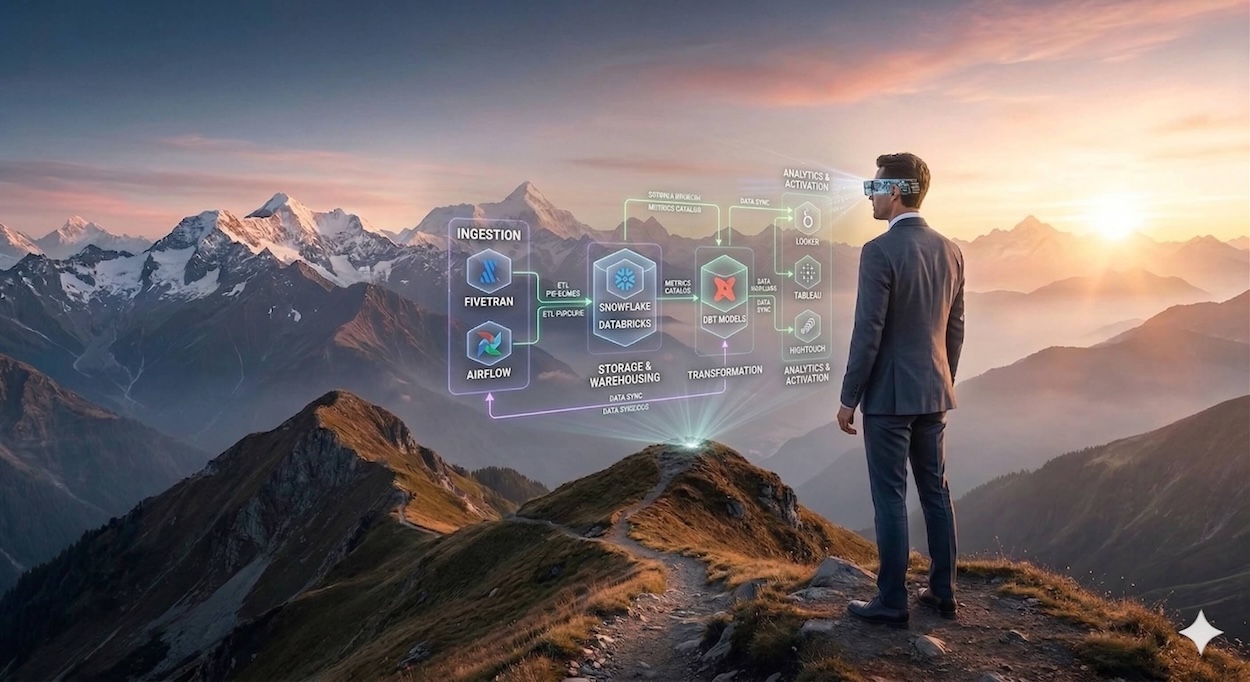
The Modern Data Stack is Back
The modern data stack is back. And this time it’s here to stay.
Data Democratization
It didn’t happen overnight. The first wave was democratization. Tools like Fivetran and Stitch made getting data into a warehouse almost trivial - what previously required messy, hand-rolled pipelines and specialized engineering talent became a configuration exercise. Data engineering went from dark art to commodity.
That was the unlock. Once data ingestion was solved, everyone could consolidate their data in one place. Snowflake made storage and computation so cheap that there was no longer a reason not to.
The dbt Turning Point
Then dbt showed up. And it changed everything.
Reproducible workflows. Code not weird UIs. Productized analysis that any engineer could understand, version control, and build on. dbt didn’t just improve the workflow - it professionalized it. Repeated work got packaged. Best practices got shared. The amount of packages in the dbt ecosystem today tells you everything about how right that idea was.
The modern data stack wasn’t just a trend. It was the correct architecture.
The Headcount Problem
So what killed it for smaller organizations?
The headcount.
Not because analysts aren’t valuable. Because they’re expensive. And for a lot of companies - especially smaller ones - the return didn’t justify the investment.
You had clean data, great models, and solid infrastructure. And then you needed a team of people to sit on top of it, interpret it, build dashboards, answer questions, run reports.
The juice wasn’t worth the squeeze.
So companies gave up. They outsourced. They bought vertical point solutions - one vendor for attribution, another for churn, another for revenue analytics. Simpler. Cheaper. But slow. Siloed. And extracting maybe 30% of what the data could actually tell them.
AI: The Last Mile Solution
Here’s what changed.
AI just made the analyst layer essentially free.
You don’t need a team of people sitting on top of your dbt models anymore. You need the models, a semantic layer that gives AI the context it needs, and an LLM. That’s it. The analysis is fast, the insights are deeper than any single analyst could produce, and the cost is a fraction of what it was.
The modern data stack was never the problem. The last mile was too expensive.
AI just built it for you. That’s what we’re doing at FrontierOps.